
Quand avez-vous réfléchi pour la dernière fois au filtre de votre fournaise ou de votre radiateur? Pour de nombreux propriétaires, c'est hors de vue et hors de l'esprit... jusqu'à ce que le filtre commence à exiger de l'attention par un débit d'air réduit ou une accumulation visible! Ce petit équipement CVC, votre filtre de fournaise MERV, fait plus que simplement capturer la poussière. Il influence la qualité de l'air, l'efficacité du système et même les coûts d'énergie. Choisir la bonne cote MERV et le bon type de filtre (filtres de fournaise réutilisables vs filtres à air jetables, par exemple) peut faire une différence surprenante.
Comprendre les cotes MERV
MERV signifie Minimum Efficiency Reporting Value, un système de cote standardisé établi sous la norme ASHRAE 52.2. Il mesure l'efficacité d'un filtre à air pour capturer les particules en suspension comme la poussière, le pollen, les squames d'animaux et les spores de moisissures. Dans les maisons canadiennes, les systèmes CVC résidentiels utilisent couramment des filtres de fournaise MERV cotés entre 5 et 13, selon la conception du système et les besoins en qualité de l'air.
De nombreux professionnels CVC recommandent des cotes de filtres de fournaise MERV mi-gamme (couramment MERV 7 à 8) comme équilibre pratique entre filtration et débit d'air. Bien que la norme ASHRAE 62.2 fixe une référence de filtration résidentielle minimale à MERV 6, des cotes MERV plus élevées peuvent être utilisées si le système CVC est conçu pour les gérer. Vérifiez toujours les spécifications du fabricant avant de mettre à niveau votre filtre.
Tableau des cotes MERV : ce que les chiffres signifient vraiment
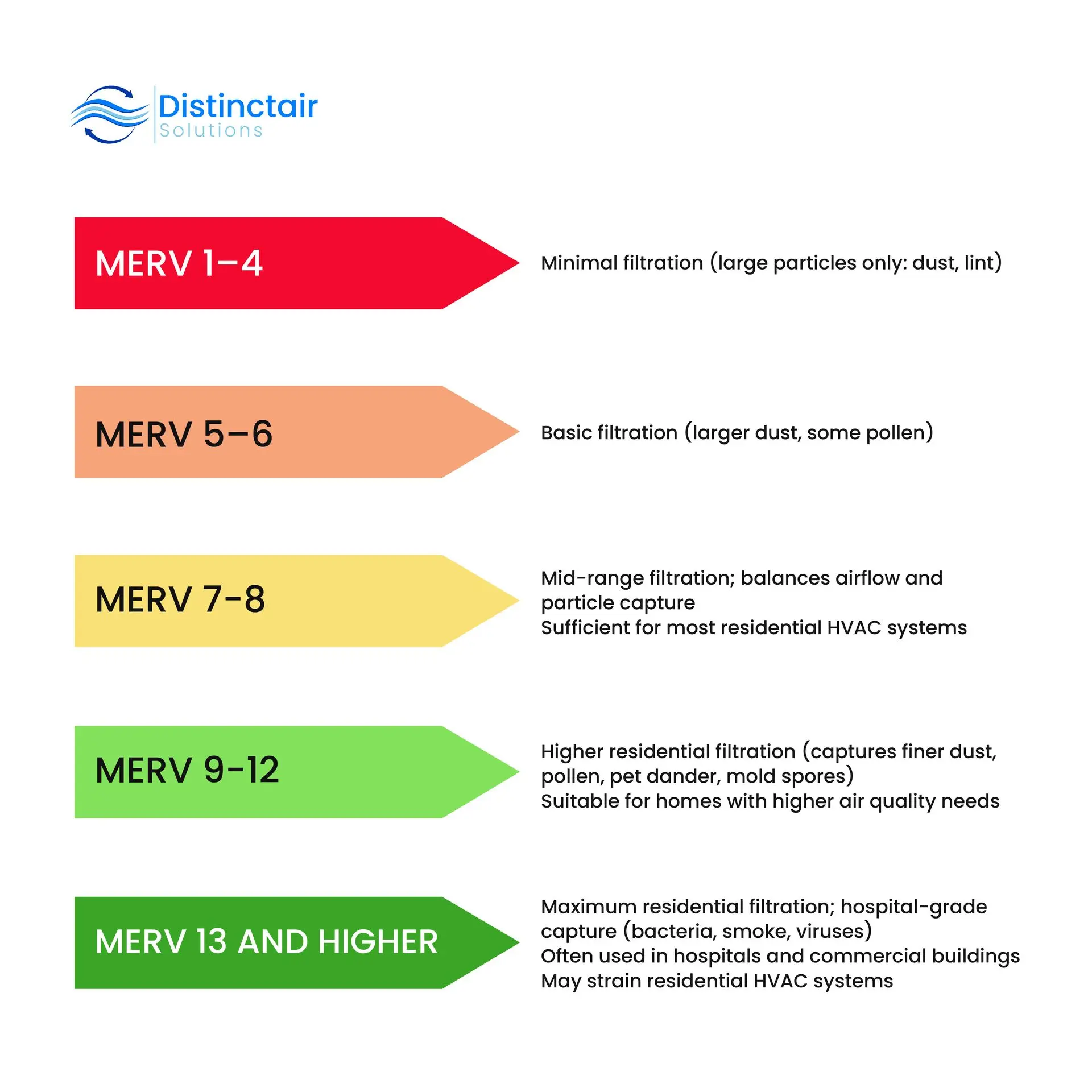
Comprendre les filtres de fournaise MERV devient beaucoup plus facile lorsque vous voyez comment chaque cote de filtre de fournaise MERV fonctionne dans la vie réelle. L'échelle MERV, définie par ASHRAE, s'applique également au Canada et aide les propriétaires à comparer les performances de filtration entre différentes cotes MERV. Voici une présentation simple des cotes MERV résidentielles courantes et de leurs meilleures utilisations :
MERV 1 à 4
Capture les grosses particules comme la charpie et la poussière. Ces filtres offrent un nettoyage d'air minimal et ne sont généralement pas idéaux pour maintenir une bonne qualité de l'air intérieur.
MERV 5 à 6
Capture les plus grandes particules de poussière et une partie du pollen. Ces filtres offrent une amélioration modeste de la qualité de l'air intérieur et MERV 6 répond aux directives de filtration résidentielle minimale d'ASHRAE, mais de nombreux allergènes plus petits passent toujours.
MERV 7 à 8 (Filtration standard pour les maisons)
Capture la poussière, le pollen, les squames d'animaux et les spores de moisissures sans restreindre le débit d'air. Cette gamme offre un fort équilibre entre filtration et efficacité du système, ce qui la rend idéale pour la plupart des systèmes CVC résidentiels.
MERV 9 à 12 (Filtration améliorée pour les maisons)
Capture des particules plus fines comme la fumée et les allergènes plus petits. Convient aux maisons avec des besoins plus élevés en qualité de l'air, comme les ménages avec des animaux ou des personnes souffrant d'allergies. Cette gamme est recommandée par ASHRAE pour une filtration de qualité dans les maisons résidentielles.
MERV 13 et plus (Filtration haute efficacité)
Capture des particules très fines, notamment les bactéries, la fumée et certains virus. Ces cotes MERV sont souvent utilisées pour les hôpitaux et les bâtiments commerciaux. Ces filtres peuvent solliciter les systèmes CVC résidentiels s'ils ne sont pas spécifiquement conçus pour eux.
Bien que les filtres à air de four MERV classés MERV 13 et plus soient de plus en plus recommandés par l'ASHRAE pour améliorer la qualité de l'air intérieur, tous les systèmes CVC résidentiels ne peuvent pas gérer ces filtres denses. Utiliser un filtre à air de four avec une cote MERV élevée dans un système incompatible peut restreindre le flux d'air, mettre à rude épreuve le CVC et augmenter la consommation d'énergie.
Conseil : Pour la plupart des ménages, les filtres de fournaise MERV de gamme intermédiaire maintiennent une filtration efficace tout en permettant à votre système CVC de fonctionner sans problème.
Filtres jetables vs réutilisables : quels filtres de fournaise MERV sont meilleurs ?
Tous les filtres ne sont pas créés égaux, même à la même cote MERV. La construction du filtre joue un rôle majeur dans les performances réelles, surtout lors de la comparaison des options jetables et réutilisables. Les filtres jetables sont largement disponibles en cotes MERV plus élevées, allant souvent de MERV 8 jusqu'à MERV 13 pour usage résidentiel, leur permettant de capturer des particules plus petites plus efficacement.
Les filtres de fournaise réutilisables sont lavables et conçus pour une utilisation à long terme. Mais ils tombent généralement dans la gamme MERV inférieure (environ MERV 1 à 4). Certains filtres électrostatiques lavables de meilleure qualité peuvent atteindre MERV 6 à 8, ce qui est généralement considéré comme le haut de gamme que les filtres de fournaise MERV lavables atteignent dans les applications résidentielles.
Les filtres lavables avec des cotes MERV supérieures à 8 sont rares, et les performances MERV élevées sont bien plus typiques des filtres jetables. Ces filtres donnent généralement la priorité au débit d'air et à la réutilisabilité plutôt qu'aux niveaux de capture de particules plus élevés trouvés dans de nombreux filtres jetables, à moins qu'ils n'incorporent des fonctionnalités avancées comme la technologie Protair-X utilisée par DistinctAir.
Les filtres de fournaise MERV réutilisables DistinctAir vont au-delà du simple piégeage de la poussière. Leurs médias filtrants 3D spéciaux créent plus de surface pour capturer les particules, tandis que les agents antimicrobiens liés dans les fibres aident à neutraliser jusqu'à 99% des bactéries, des virus et d'autres particules nuisibles. Cela signifie que votre maison profite d'un air plus pur, moins d'allergènes et un environnement plus sain, le tout sans restreindre le débit d'air ni stresser votre système CVC.
Des cotes MERV plus élevées sont-elles toujours meilleures?
C'est une idée reçue courante que les filtres de fournaise MERV plus élevés signifient automatiquement une meilleure qualité de l'air. Bien que des cotes MERV plus élevées capturent effectivement des particules plus petites, elles créent également plus de résistance au débit d'air. Dans de nombreux systèmes résidentiels, les filtres cotés au-dessus de MERV 13 peuvent :
- Réduire le débit d'air : Votre fournaise ou radiateur peut avoir du mal à pousser l'air à travers le média filtrant dense.
- Forcer votre système à travailler plus dur : Une contrainte supplémentaire peut raccourcir la durée de vie de votre système CVC.
- Augmenter la consommation d'énergie : Plus de travail signifie des factures d'énergie plus élevées au fil du temps.
Conseil : L'objectif n'est pas les cotes MERV les plus élevées. C'est le bon équilibre entre filtration et débit d'air.
Filtres de fournaise MERV — Questions fréquemment posées
1. Quelles cotes de filtres de fournaise MERV sont les meilleures pour la plupart des maisons ?
ASHRAE 62.2 recommande un minimum de MERV 6 pour les filtres de fournaise MERV résidentiels. Pour une meilleure qualité de l'air, MERV 8 à 12 fonctionne bien, et MERV 13 est idéal seulement si votre système peut le gérer.
2. Certaines cotes MERV peuvent-elles être trop élevées pour ma fournaise ?
Oui. Les filtres cotés au-dessus de MERV 13 peuvent restreindre le débit d'air dans les systèmes non conçus pour eux, entraînant des factures d'énergie plus élevées et une contrainte du système.
3. À quelle fréquence les filtres de fournaise MERV doivent-ils être remplacés ou nettoyés ?
Les filtres jetables nécessitent généralement un remplacement tous les 1 à 3 mois. Les filtres de fournaise réutilisables doivent être lavés selon les directives du fabricant pour maintenir des performances constantes.
Le choix judicieux : filtres de fournaise MERV réutilisables avec les bonnes cotes MERV
Parfois, les plus petits changements dans le système CVC de votre maison peuvent faire une différence surprenante. Choisir le bon filtre de fournaise MERV (en particulier un réutilisable de haute qualité) offre plusieurs avantages aux propriétaires :
- Les filtres de fournaise MERV efficaces piègent la poussière, le pollen, les squames d'animaux et d'autres particules en suspension avant qu'elles ne circulent.
- La bonne cote MERV permet un débit d'air approprié, essentiel pour que votre fournaise ou radiateur fonctionne plus efficacement.
- Les filtres de fournaise MERV lavables offrent une utilisation à long terme et moins de déchets, tandis que les options jetables offrent généralement des options MERV plus élevées pour une filtration améliorée.
- Conceptions avancées Les conceptions avancées de filtres de fournaise lavables peuvent fournir une filtration plus efficace même à des cotes de filtres de fournaise MERV comparativement inférieures comme MERV 7 ou 8.
La clé est de sélectionner un filtre de fournaise MERV qui équilibre la capture efficace des particules avec un débit d'air optimal pour votre système CVC spécifique. Faire un choix éclairé aide à assurer un air plus pur et des performances fiables tout au long de l'année.